Color guide for Jacksonville's top HOAs
Jacksonville & Northeast FL HOA paint submission packet
Need HOA approval before painting your Jacksonville home? Learn what to include in your paint submission packet — colors, codes, sheen, LRV, photos, samples, prep details, and contractor documentation.



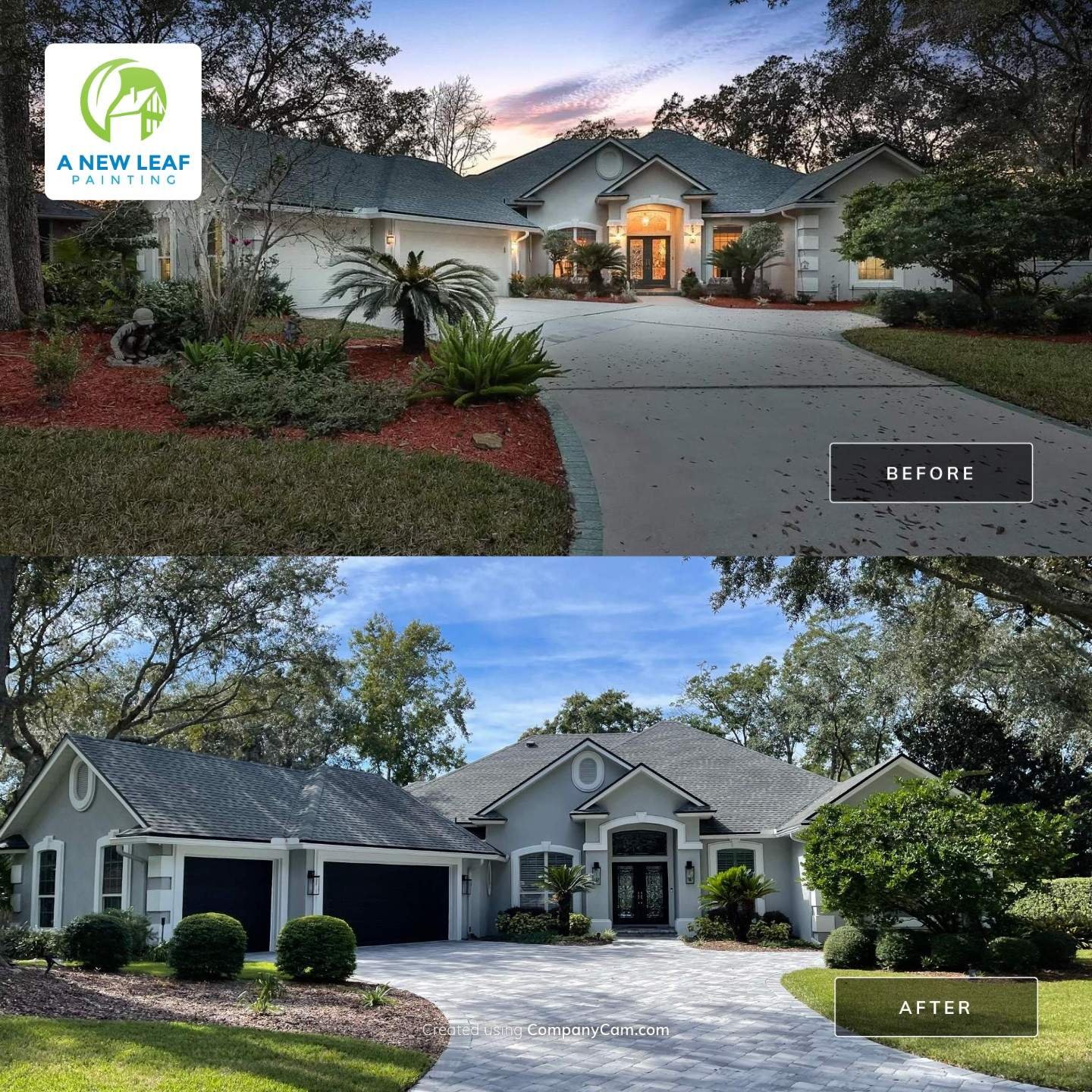 Real project
Recognized Across Northeast Florida for Quality, Care & Craftsmanship




A plain-English checklist of the colors, codes, product specs, photos, and documents your Jacksonville HOA may ask for before approving an exterior repaint — plus a sample packet format, a free printable checklist, and the most common reasons submissions get delayed.
Part of our complete Guide to HOA Painting in Jacksonville — our resource for ARB submissions, approved palettes, and HOA-compliant exterior painting across Northeast Florida.
By Thomas Drake, Founder & Owner, A New Leaf Painting Contractors · Helping Northeast Florida homeowners prepare paint specifications since 2010 · Updated June 2026
Since 2010preparing Jacksonville paint specs
700+ verified five-star reviews
The Short Answer
A complete Jacksonville HOA paint submission usually includes your property address, HOA name, body color, trim color, door or accent colors, paint manufacturer, color codes, sheen, product line, LRV (when required), photos or color samples, surface preparation details, and contractor documentation. Some communities also require an official ARB or ARC form, neighbor acknowledgement, or submission through the management company. Every HOA is different — always confirm final requirements with your association before submitting.
Important Note
Every HOA is different. This guide is general homeowner education and does not replace your community’s covenants, architectural guidelines, management company instructions, or legal advice. Always confirm final requirements directly with your HOA, ARB, ARC, ACC, property manager, or association documents before painting.
Need help preparing your HOA paint details?
A New Leaf Painting helps Jacksonville homeowners organize the paint-related information commonly requested by HOAs — color codes, product specs, sheens, LRV details, prep scope, photos, and contractor documentation.
What is an HOA paint submission packet?
An HOA paint submission packet is the information your homeowners association or architectural review board uses to approve your exterior paint project before work begins. Different communities call it different things — an ARB application, an ARC submission, an architectural change request, or a design review packet — but the function is the same.
The packet typically covers the colors you want to use, where each color will be applied, product specifications (manufacturer, product line, sheen), photos or color samples, surface preparation details, contractor information, and any required HOA forms.
The HOA reviews this against your community’s covenants, conditions, and restrictions (CC&Rs) and its current architectural guidelines. If everything matches the approved standards and the packet is complete, the application is typically approved. If anything is missing or unclear, it is usually returned for clarification — which can mean waiting for the next review cycle.
Why complete documentation matters more than the color
Most homeowners assume the hardest part of an HOA paint application is picking a color the review board will like. After preparing paint specifications across Northeast Florida since 2010, what we see most often isn’t color rejection — it’s incomplete information.
Many HOA paint applications are delayed on the first review because they are incomplete, not because the color is automatically wrong. Missing color codes, sheen details, LRV values, photos, samples, or contractor documentation can push the request into another review cycle.
Why first-pass completeness matters: An incomplete submission can delay approval and may push the work beyond your preferred scheduling window. Getting the packet right the first time is the simplest way to protect your timeline.
The items below are commonly requested in Northeast Florida HOA exterior-paint applications. Your community may require fewer, additional, or different documents — always confirm the active requirements with your HOA or management company first.
What an HOA paint submission packet usually includes
- 1
The architectural change application form
Commonly Requested
The current version of your community’s application — sometimes called an Architectural Review Request, Architectural Modification Request, or Design Review Application. Pull it directly from your management company’s portal; communities update forms periodically, and an outdated version can trigger a rejection. Complete every field, sign, and date it. Joint owners, trusts, or LLCs typically require the appropriate signatures.
- 2
Paint manufacturer and product line
Commonly Requested
Specify the manufacturer and the specific product line, not just the brand name. Sherwin-Williams® and Benjamin Moore® both offer multiple exterior coating systems. The right product depends on the substrate, exposure, condition of the existing coating, desired warranty coverage, and project scope.
Body coat: [Manufacturer] [Exterior product line]
Trim coat: [Manufacturer] [Exterior product line]
Doors/Shutters: [Manufacturer] [Trim/door enamel]
- 3
Exact color names with manufacturer codes
Commonly Requested
Color names alone are usually not enough. Boards typically want the manufacturer’s color code so they can verify the color, confirm the LRV, and compare it against the approved palette. Specify body, trim, and accent colors separately, and list each placement for multi-color homes.
Body (stucco): Accessible Beige, SW 7036
Trim: Alabaster, SW 7008
Front door: Iron Ore, SW 7069
Shutters: Iron Ore, SW 7069
- 4
Sheen for each color
Commonly Requested
Sheen — flat, satin, semi-gloss, or gloss — affects how the color reads and how the film performs. Many standards specify sheen separately for body, trim, and accents, so list a sheen for each surface rather than a single color name.
- 5
Light Reflectance Value (LRV) for each color
When Required by Your HOA
LRV is a number from 0 (black) to 100 (white) measuring how much light a color reflects. Some Jacksonville communities specify LRV ranges — often for body walls, with separate ranges for trim and accents. Manufacturers publish LRV in their color cards and online databases.
Body: Accessible Beige (SW 7036) — LRV 58
Trim: Alabaster (SW 7008) — LRV 82
Front door: Iron Ore (SW 7069) — LRV 6
- 6
Color placement plan
Commonly Requested
A written description — and ideally a simple sketch or annotated photo — showing where each color goes: body on walls, trim on fascia/soffits/casings, accent on shutters and front door, garage door to match body. This is where many submissions stall: three colors are listed, but the board can’t tell which goes where. If your community provides a fillable diagram, use it.
- 7
Physical color samples or painted boards
When Required by Your HOA
Some communities request manufacturer chips, large-format color cards, painted sample boards, or on-home samples — confirm your HOA’s current requirement before purchasing or preparing samples. Physical samples matter because monitors and printed brochures distort color; a soft beige on a chip can read pink-orange on a south-facing wall in afternoon Florida sun.
- 8
Current property photos from all elevations
Commonly Requested
Many communities ask for several current photos showing all elevations — front, sides, rear, plus close-ups of features that affect color placement (gables, columns, dormers). Take them recently, in good daylight, at high enough resolution to see detail. Avoid old listing photos or Street View captures.
- 9
Surface preparation scope
Commonly Requested
Prep is half the job on any exterior repaint, and boards know it. A clear prep scope typically describes pressure washing, dry time, scraping and sanding, primer where appropriate, caulking, any wood or stucco repair, masking, and the number of topcoats. Submissions that spell out prep tend to clear more smoothly than ones that gloss over it.
- 10
Contractor insurance, business, and qualification documentation
Commonly Requested
Many HOAs ask for proof the contractor is properly registered, insured, and qualified for the work. Depending on the project, that can include a certificate of general liability insurance (sometimes with the HOA as additional insured), workers’ compensation or exemption documentation, business name and address, applicable registration information, warranty terms, and a written scope of work matching the submission.
For approved projects, we can provide the paint-related specifications and business documentation requested in the written scope or by the HOA, subject to the community’s requirements. Our process and Iron-Clad Guarantee page explains how we document each project.
- 11
Estimated project timeline
Commonly Requested
An estimated start and completion date so the board knows when work will be visible. Many full-home exterior projects take roughly 5–10 working days, but timing depends on home size, repair scope, access, weather, dry time, and approved change orders — so give a realistic window rather than a tight promise.
Optional but recommended: a short reference document listing a few completed projects in a similar HOA community, with dates. Boards aren’t required to review references, but offering them voluntarily signals professionalism and can shorten internal back-and-forth.
Free Download · Jacksonville Homeowners
Get the HOA Paint Submission Checklist
A free, printable one-page checklist plus a fill-in sample packet template, so you can confirm the color codes, sheens, LRV values, photos, product specs, and contractor documents your HOA may ask for before you submit.
What a complete packet looks like
Here’s the shape of a complete submission, formatted as a typical Northeast Florida HOA repaint. Use it as a model — substitute your home’s actual address, your community’s actual ARB form, and the colors and products from your own project.
Sample Format · Based on Common Northeast Florida Requirements
A complete packet, at a glance
- 01HOA / ARB application form — current version, completed, signed, dated
- 02Color schedule — body, trim, doors, shutters, garage (name + code)
- 03Product & sheen — manufacturer, product line, and sheen per surface
- 04LRV sheet — for each color, when your community requires it
- 05Color placement plan — what color goes where, in writing
- 06Current property photos — all elevations, recent, good daylight
- 07Surface preparation & scope of work — wash, repairs, caulk, primer, coats
- 08Contractor insurance & business documentation — as required
- 09Estimated project timeline — realistic start and completion window
A complete packet leaves nothing for the board to assume: every color has a code, every surface has a sheen, the prep scope is specific, and the contractor information is documented.
Common reasons HOA paint submissions get delayed
Most delays aren’t because the homeowner chose a bad color — they happen because the submission is incomplete or unclear, which forces the board to ask for more information. Here are the patterns we see most:
Missing color codes
“Tan body, white trim” without manufacturer codes. The board can’t verify the color, check the palette, or confirm LRV.
Color names without numbers
The same color name can exist at multiple manufacturers. Always pair the name with the manufacturer’s specific code.
Sheen not specified
Colors listed with no sheen for any of them. Many boards require sheen specified separately per surface.
Unclear color placement
Colors approved but no description of which goes where. Always include a written placement plan.
Missing LRV when required
Some communities require LRV for each color. Submitting without it can stall the application.
Forgotten surfaces
Body and trim listed but garage door, shutters, or front door left off. Address every visible surface.
Off-palette without a variance
Choosing a color outside the community’s approved list without explicitly requesting a variance.
Missing prep or contractor docs
“We will paint the exterior” with no prep details, or no insurance/business documentation the HOA requires.
Old or low-quality photos
MLS listings, Street View, or years-old phone shots. Boards want current photos in good daylight, all elevations.
What your contractor provides vs. what you submit
The HOA application is technically the homeowner’s responsibility — your name, your signature, your property. But preparing the technical content is where a knowledgeable Jacksonville painting contractor makes the process much easier.
What a good contractor can provide
- Complete product specs — manufacturer, product line, and sheen broken out by surface
- Exact color codes verified against the manufacturer’s current published data
- LRV information when available and when your community requires it
- Color placement plan in writing
- Painted sample boards when your community asks for them
- Detailed prep scope — washing, dry time, primer, caulking, repairs
- Insurance and business documentation as required
- A realistic project timeline
What the homeowner submits
- The completed application form (signed and dated)
- Current property photos
- The contractor’s spec details attached as exhibits
- Any community-specific supplemental forms
- Neighbor acknowledgement, if required
When you hire A New Leaf Painting for an HOA exterior repaint, we help organize the paint-related details so you’re not guessing on the technical fields. You still sign and submit — but the spec details shouldn’t be a homework assignment.
What A New Leaf Painting can and cannot do
HOA approval is a process between the homeowner and the association. We help with the parts where painting expertise matters — and we’re transparent about the parts no contractor controls.
We can help with
- Paint color documentation
- Manufacturer names and color codes
- Product line recommendations for Florida conditions
- Sheen recommendations
- LRV information when available
- Prep and scope descriptions
- Insurance and business documentation
- Painted sample boards when needed
- Guidance on common submission requirements
- Exterior painting after written approval
We cannot
- Guarantee HOA approval
- Override your HOA rules
- Sign the homeowner application for you
- Provide legal advice
- Control ARB meeting schedules
- Promise automatic approval
- Submit as the homeowner unless your HOA permits it
- Speed up your management company’s review
We recommend homeowners confirm final requirements directly with their HOA, property manager, or architectural review board before submitting any application.
Five quick checks before you commit
These are the questions that catch homeowners off guard most often. A few minutes up front can save weeks of resubmission later.
- Is the color on your HOA’s approved palette? Many communities maintain pre-approved lists. Going outside one is possible but often requires a variance request and a longer review.
- Does your HOA require a minimum or maximum LRV? Some communities specify LRV ranges for body walls, with separate ranges for trim and accents. Confirm your community’s actual requirement before selecting.
- Does the body color work with your roof? Especially important in stucco-and-tile communities, where the body color must complement the existing roof.
- Are neighboring homes using similar colors? Some communities enforce same-color adjacency rules, so your immediate neighbors and the home across the street may not be able to share your body color.
- Does your HOA restrict dark trim, black doors, or bold accents? Some allow what others restrict — check before you fall for a deep navy door or black trim.
For approved palettes by community, see our Jacksonville HOA Paint Color Guide.
Do you need approval to repaint the same color?
In many Jacksonville communities, yes. Even repainting the same color, the association may still require written approval before exterior painting begins. Some HOAs offer a simplified or expedited review for same-color repaints — confirm this in writing before scheduling.
The risk of skipping the request: if the existing paint has faded over several years, the fresh coat won’t match what the board has on file, and that mismatch can trigger a violation even though you used the “same” color. The safer path is a brief written request stating “repainting in [color name and code], same as existing,” with current photos attached.
Already received a notice?
Don’t panic — but don’t ignore it either
If your HOA sent a notice about faded paint, peeling paint, mildew, or an unapproved color, the worst move is to wait. Many HOAs give a set window (often 30 to 60 days) to come into compliance, and fines that accrue after that can add up.
Review the notice carefully, confirm exactly what the HOA is requesting, and prepare a clear repaint plan with colors, products, prep details, and a timeline. If the fix requires returning to an approved color you no longer have on file, the HOA office or management company can usually provide the original approved palette or color records.
Bring Your Violation Letter to Your Estimate
The faster a complete packet gets in front of the board, the faster the violation tends to close.
When should you submit your HOA paint request?
Most HOA paint approvals are not instant. Some communities review weekly, others monthly or only at scheduled ARB meetings. To avoid delaying your project, submit your request before locking a firm start date.
Best practices
- Submit early. Plan to submit several weeks before your preferred start date.
- Don’t schedule the crew until approval is confirmed in writing. Verbal approval doesn’t count.
- Keep written approval on file. Save the email or letter with your records.
- Confirm whether approval expires. Some communities require work to begin within a set number of days.
Florida-specific timing note: The strongest exterior painting window in Northeast Florida tends to run fall through spring — lower humidity, cooler temperatures, and fewer afternoon storms. If you want a fall start, begin assembling your packet in late summer; for a spring start, begin in mid-winter.
Requirements vary by community, sub-association, architectural review board, and current governing documents. Always confirm the active rules and submission process directly with your HOA or management company before making color or project decisions. For management contacts and submission methods across Northeast Florida communities, see our Jacksonville HOA Master Directory.
Continue reading: Jacksonville HOA painting guides
- The Complete Guide to HOA Painting in Jacksonville — the pillar resource
- Jacksonville HOA Paint Color Guide — approved palettes and LRV guidance
- Jacksonville HOA Master Directory — management contacts and submission methods
- Refinishing in San Marco — working in Jacksonville’s historic districts
- Exterior Painting Services
- Color Consultation Services
- Our Process & Iron-Clad Guarantee
- Recent Painting Projects
Frequently asked questions
Most Jacksonville HOA communities require written approval before exterior painting begins. The covenants typically require approval for any exterior change visible from the street, and a fresh coat of paint qualifies — even repainting the same color often requires at least a brief written request. Always confirm with your management company before scheduling work.
Free estimate
Ready to paint but not sure what your HOA needs?
SINCE 2010 · 5,000+ PROJECTS · 700+ VERIFIED FIVE-STAR REVIEWS · IRON-CLAD GUARANTEE
- Fast scheduling available
- Office Mon to Sun, 7am to 7pm
- Fully licensed and insured, with $3M+ in coverage

Request a callback
Tell us about the job and we call back to book a walkthrough. No obligation.